Emulsification
Perfect control of emulsion production
The Secoya emulsification technology is based on the integration of the most efficient microfluidic technologies in a robust stainless-steel equipment.
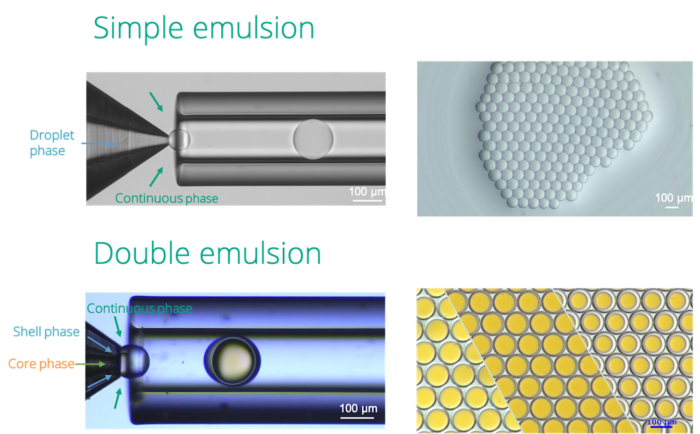
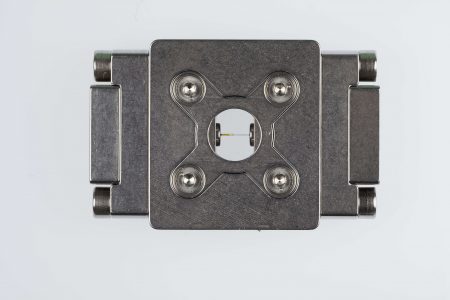
The way we produce droplets, particles and capsules relies on the use of couples of capillaries perfectly aligned in a metallic reservoir. The first capillary is terminated with a 3D-printed nozzle and injects the droplet phase in the junction. The second one is the only output of the system, so it collects both phases, the droplet phase and the continuous phase filling the reservoir under pressure.
The droplets are produced by the controlled squeezing of the droplet phase by the continuous phase at the entrance of the collection capillary
Robust and reliable technology
Our unique integration of a microfluidic technology in a robust device allows us to produce droplets and particles with the key benefits of both worlds: a high control of the particle size and a robust long-run production process.
- Particle size : 20 to 400 µm
- API encapsulation efficiency : >95 % (e.g. in PLGA)
- Size distribution : dispersity <2%
- High frequency : > 1000 droplets per second (kHz) per injector
- Surfactant free : no need of surfactant
- Robustness : as no coating is required inside the capillaries, compatibility with long-run production
- Encapsulation versatility : both hydrophobic and hydrophilic ingredients can be encapsulated using the same technology
- Scalability : through number-up
Integrated solution for single and double emulsion production
We offer a fast and easy-to-use solution for producing single and double emulsions with the Raydrop Platform, an instrument that integrates all the peripherals needed to operate the Raydrop. An optional sample injector enables work with very small amounts of compound, making it a suitable solution for fast screening.

Potentiel applications
- Monodispersed PLGA particles
- Monodispersed particles of UV-curable resin
- Efficient encapsulation of active ingredients such as proteins, genetic material and fragrances, whether hydrophobic or hydrophilic
- Encapsulation of active ingredient non soluble in the solvent used to dissolve the polymer
Frequently Asked Questions
It is the integration of a cargo – an API, peptide, virus, cell, nucleic acid or any other substance – into a liquid or solid particles which can be droplets, beads, double emulsion or core-shell capsules with a solid shell surrounding a liquid core.
Encapsulation increases stability and shelf-life, enables controlled and gradual release, protects the cargo against enzymatic or acidic degradation, and can reduce side effects. It also supports cell isolation for FACS sorting, combination of several actives, and allows cell culture for gene therapy.
From 25 µm up to 1 mm, depending on the design of the injection nozzle and collection capillary.
Yes. Water-soluble compounds can be encapsulated in an aqueous core within a PLGA or PEGDA shell, among others; lipophilic or organic-solvent-soluble compounds in an oily core within a chitosan shell, among others.
Microfluidic droplet generation gives consistent capsule size and structure from run to run, which is the main limit of conventional emulsification methods. The throughput depends on the droplet size and will go from kHz for small droplets to tens of Hz for big droplets.
Yes. Case studies include lysozyme in PLGA beads, bacteria in W/O/W double emulsions for FACS, biomaterials in alginate hydrogel beads and protein crystallisation inside microcapsules with a polymeric shell. Lien vers les publications Chem Com et Lab on a Chip ici.
1 mL of solution. Screening runs on the SCT-LAB 1 mL unit, so early crystallization trials can start with as little as 1 mL.
Want to know more about the EMULSIFICATION TECHNOLOGY?
Want to know more about the EMULSIFICATION TECHNOLOGY?
Question ? Contact us by filling in the contact form below.